
June 11, 2026
There was a time when AV sat comfortably on the edge of the network. More isolated. Quieter. Mostly someone else's problem.
That world is gone.
Today, displays, microphones, control panels, cameras, DSPs, room booking panels, wireless presentation systems, and digital signage players are all sitting on the network. And once they are on the network, they stop being just room devices. They become part of the school's wider technology environment.
AV and IT have fully merged
The convergence has been coming for years. AV-over-IP platforms, cloud-managed control systems, digital signage players, room scheduling panels — they all sit on the same infrastructure as business-critical applications. That brings real advantages. Systems can be easier to monitor, easier to manage, and more flexible to deploy across a campus.
It also means every connected AV device becomes another endpoint that needs to be considered properly.
From an IT or security team's perspective, an AV device is no different from any other network-connected system. It has firmware. It has ports. It communicates with external services. Which means it can be exploited.
Essential 8 · ISE CyberSecurity Summit 2026
Industry bodies including AVIXA have been clear on this. For Australian organisations, this lands squarely within the Essential 8 maturity model. AV has historically been a soft target: outdated firmware left untouched, devices sitting on unsegmented networks, default credentials nobody changed after install. These aren't edge cases. They're patterns that show up repeatedly across the industry.
The question has changed
It used to be enough to ask: does the room work? That question still matters. But it's no longer the only one.
The questions IT managers and their security teams are now asking — and should be asking — sound more like this:
- Where does this device sit on the network?
- What risk does it introduce?
- Was security considered from the start, or bolted on later?
- Who's responsible for firmware updates and patching?
- What happens when something goes wrong?
If an AV integrator can't answer those questions confidently, that's worth paying attention to.
What secure-by-design AV actually looks like
This isn't about adding a security checklist at the end of a project. It's about building security into the design from day one.
Hardware built with security in mind
Procurement should favour devices with secure boot capabilities, signed firmware updates, and a clear manufacturer commitment to ongoing vulnerability disclosure and patching. If a product has no documented update lifecycle, that's a problem the school inherits.
Network segmentation
AV devices — smart displays, room scheduling panels, cameras, DSPs — should operate on isolated VLANs, separated from the rest of the school network. This limits the blast radius if something is compromised.
Encrypted signal transport and strong access control
Management interfaces need role-based access control and multi-factor authentication. Default credentials, vague ownership of admin access, and unclear management pathways are all avoidable problems. Schools need to know who can access what, how that access is controlled, and what happens after handover.
Active monitoring
The AV ecosystem needs to be included in network monitoring and threat detection frameworks — not treated as a separate, invisible layer. That is where a lot of risk sits in practice. Not in the hardware itself, but in the gap between install and long-term ownership.
What this means for schools
In a private independent school environment, the stakes are real and the exposure points are multiplying.
Think about what's on the network: interactive flat panels in every classroom. Room booking systems in the corridors. PA and bell infrastructure the whole campus depends on. CCTV. Video conferencing systems used for board meetings and parent communications. Digital signage updated from a central server.
Every one of those devices is a potential entry point. And if something is overlooked, it is rarely the AV partner who feels the pressure first. It is the IT Manager.
Most school IT teams are already stretched. They are carrying infrastructure, support, cybersecurity, procurement pressure, and day-to-day operations. If AV is added to that mix without proper design thinking, it becomes one more source of avoidable risk — and one more category they are expected to manage after the fact.
That is also why the AV partner conversation has changed. The question is no longer just: "can they install it?" The real question is: do they understand the environment this system needs to operate in?
The AV partner's role has changed
For a long time, network security was someone else's problem. AV installers focused on the room. Firewalls and authentication policies were the IT team's domain. AV just needed to connect.
That's not a sustainable position anymore.
When an AV device touches the network, it becomes part of the organisation's security posture. That means integrators need to understand how their systems interact with enterprise security frameworks — NIST, Zero Trust, 802.1X authentication, VLAN segmentation. Not to replace the IT team, but to work alongside them without creating unnecessary risk.
It also means asking better questions during the design phase, not just the sales phase. What compliance standards does this network need to meet? How is the IT team structured? Who owns firmware updates after handover? Is security designed in, or is someone expected to fix it later?
How The Big Picture Group approaches this
At TBP, we have always believed that complexity is the enemy of reliability. A room that's over-engineered is harder to operate, harder to support, and harder to defend. That philosophy applies just as directly to cybersecurity.
This isn't just a slogan. It's a core lever in our Genius Model — the framework that shapes how every project is designed and delivered. Of the levers that drive client outcomes, Design & Engineering sits at the front. It determines how stable a system is, how supportable it is, and how defensible it is once it goes live.
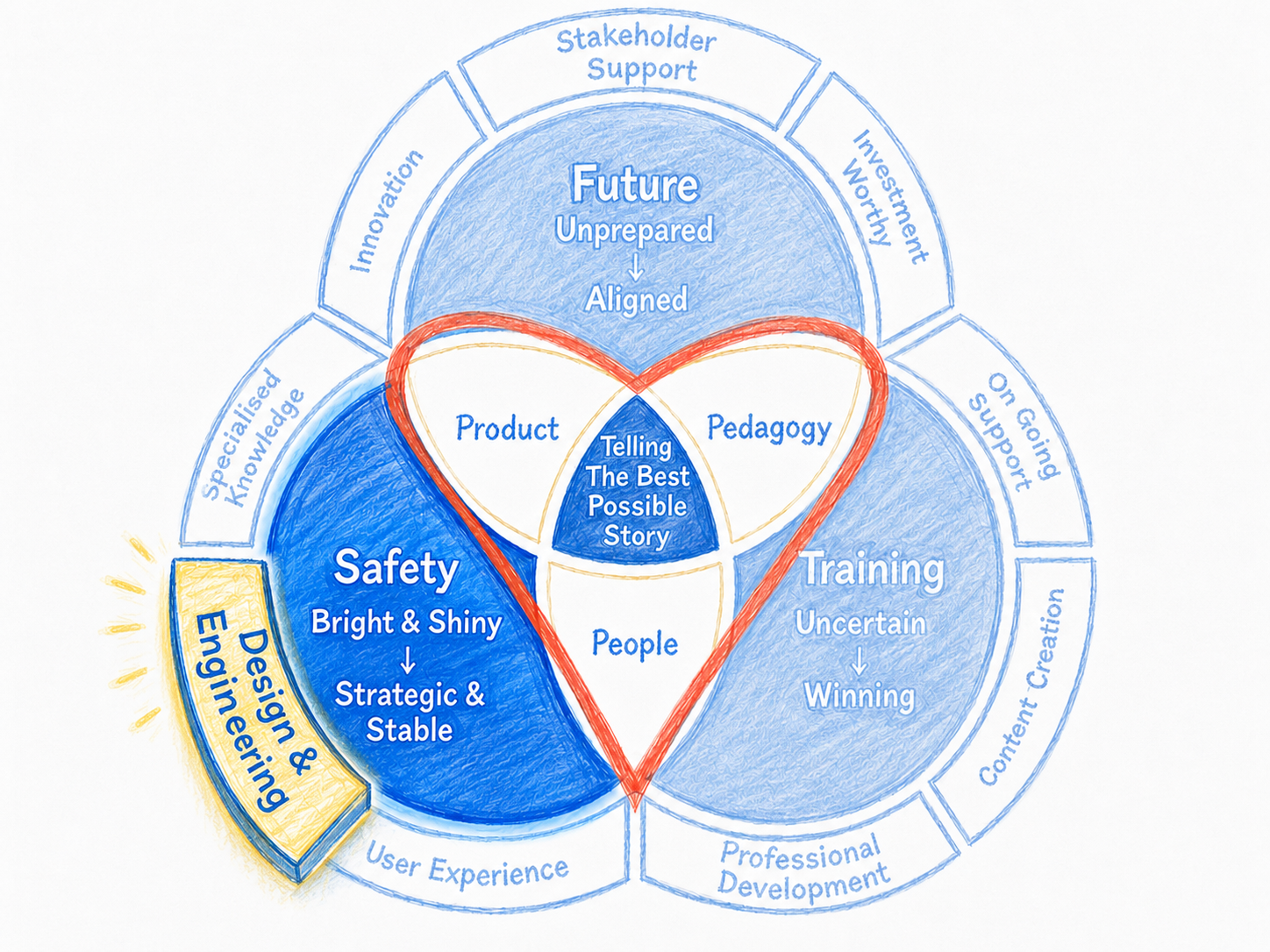
Cybersecurity isn't a separate conversation sitting outside the AV design. It belongs in the Design and Engineering phase — where hardware is specified, network architecture is decided, access models are set, and handover is planned. Get those decisions right at the start, and security follows. Get them wrong, and someone else inherits the problem.
The Big Picture Group View
Systems designed with unnecessary complexity are harder to monitor, harder to update, and harder to keep secure over time. So the approach doesn't change: design it properly from the start, keep it as simple as it needs to be, and make sure the people who inherit it can actually manage it.
That means thinking beyond the room itself. It means specifying hardware with a clear support path. It means designing systems that fit into real school networks. It means having the conversation about ownership, access, updates, and accountability before the room goes live.
TBP is not a cybersecurity firm. But the systems we design sit inside real school environments with real governance, real support pressure, and real consequences if something is overlooked. That reality is built into how projects are designed and handed over.
Secure-by-design is part of competent AV delivery in 2026. If an AV partner isn't having that conversation with you, it's worth asking why.
If your school is planning an upgrade, a new build, or a broader campus AV rollout, this is one of the questions worth getting right early. Not after handover. Not after a problem. At the design stage, where it belongs.
Get it right at the design stage. Not after handover.
The Big Picture Group designs and delivers AV and telecommunications infrastructure across Queensland, with a primary focus on larger private independent schools. If you're planning a new build, upgrade, or campus standardisation project — get in touch.
Talk to Our Team →


Most Recent Posts
.png)
Connect With Us
Ready to enhance your communication and storytelling? Discover our range of innovative technology solutions. Let's connect and take your experience to the next level